My two cents on the “meaning of life”
One day after senior year finals in college, my roommate and I, still wired on ten hours of caffeine, found ourselves deep in conversation.
Somewhere between the scattered Red Bull cans and philosophical tangents, I discovered what I believe to be the meaning of life.
Let me explain.
Imagine two mathematical functions:
y = x {x > 0}
y = -x {x > 0}
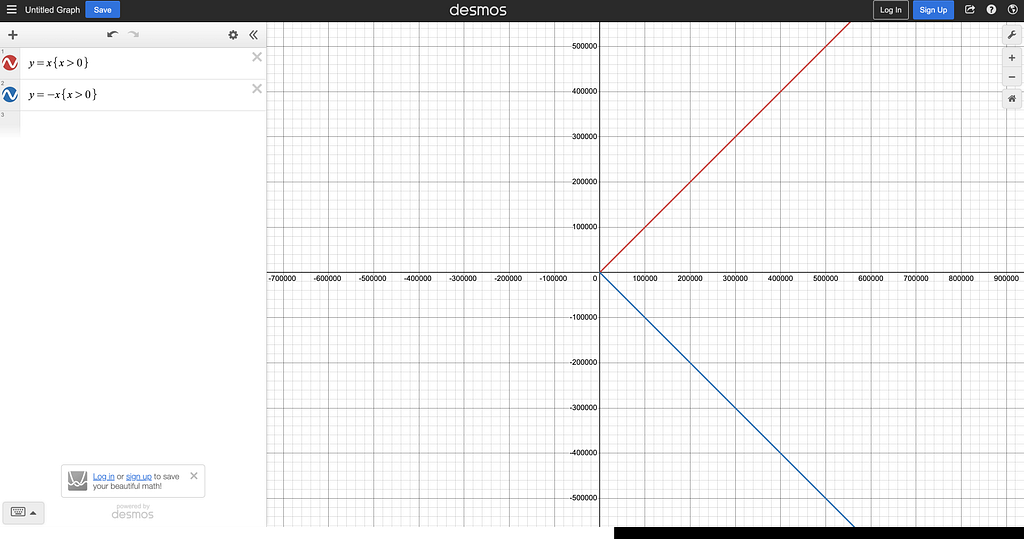
These lines expand infinitely in opposite directions, yet they meet at a single point: the origin.
Now, picture that origin as the first event that ever occurred in the universe. We currently call it the Big Bang, but we can’t be completely sure. Regardless of what it truly is, that singular moment is the seed from which everything sprang forth: galaxies, the laws of physics, even conscious thought.
As humanity evolves, our tools and minds improve. We develop sharper telescopes. We build more precise sensors. We imagine smarter theories.
In essence, we’re moving further along the lines of those functions, with each step taking us closer to understanding that singular origin.
Up until recently, this progress was made through sheer human thought. Think Newton with his apple. Darwin observing the Galápagos. Curie in her lab coat, uncovering the radioactive unknown. Every discovery was a push forward.
What once was myth is now science.
We used to believe the sun was pulled across the sky by Helios in a golden chariot.
Now we know it’s caused by Earth’s rotation on its axis.
Lightning was once thought to be Zeus hurling bolts from the heavens.
Now we know it’s caused by a sudden discharge of electricity between charged regions in the atmosphere.
Diseases were blamed on curses or “bad air.”
Now we can trace pathogens down to their molecular structures.
Step by step, imagination has given way to understanding. And with each breakthrough, we narrow the gap between now and the beginning.
That, I believe, is the meaning of life:
To help humanity inch closer to fully understanding the first event. To contribute, even in the smallest way, to the pool of human knowledge that might one day reveal the full story of how we came to be.
It’s the ultimate goal.
The greatest unanswered question.
The quiet engine behind every microscope slide, every particle collider, every coded simulation.
Some philosophers spiral into despair while pondering these existential questions.
They look up at the stars and feel insignificant. They conclude that we’re just specs on a rock, floating through a cold indifferent cosmos.
But I argue the opposite.
There is peace in knowing that you are part of something bigger: a relay race of thinkers, builders, researchers, creators, with each moving the torch a bit closer to the truth.
Whether you’re Einstein reshaping modern physics or an anonymous PhD crunching datasets, your contribution matters.
And now, more than ever, we’re standing on the edge of something new: the age of artificial intelligence.
AI isn’t just a faster calculator. It’s a second brain for humanity. One that never tires, never forgets, and can process in moments what would take us lifetimes.
For the first time in history, we have a tool that can absorb every scientific paper ever written, test hypotheses at scale, and improve upon past knowledge with exponential speed.
What human researchers do (form hypotheses, test them, refine ideas, repeat) can be broken into logical steps.
And anything rooted in logic is, by definition, programmable.
Of course, this belief stretches far beyond scientific discovery (I’d be happy to write about that in other posts). But this essay isn’t about that.
This is about the unapologetic conviction that we are not here by accident.
So yes, the meaning of life may have come to me on a random weekday, high on caffeine and wonder.
But I abide by it.
We exist to move the needle.
We exist to help humanity understand where it began.
And I truly believe, rather optimistically, that with the help of AI, we might just see the answer in our lifetime.